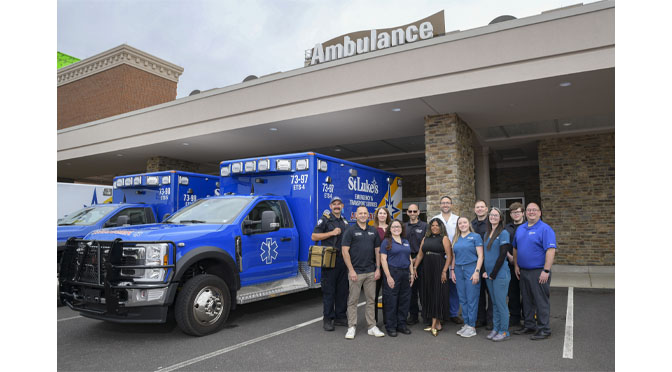


Photo caption: SLETS employees in front of special critical care transport (CCT) ambulances equipped for whole blood transfusion. Chris Zukowski is second from left.
In recent months, St. Luke’s ambulances equipped with whole blood have saved numerous lives, including car accident survivors and a gunshot victim.
Whole blood is a powerful, lifesaving tool because, unlike IV fluid, it contains vital components – red blood cells, white blood cells, platelets and plasma, explained Chris Zukowski, MSN, RN, of St. Luke’s Emergency and Transport Services (SLETS).
“Communities served by St. Luke’s ambulances with whole blood are incredibly fortunate, because it is a real game-changer for first-responders,” he said. “Most other ambulance corps do not have the sophisticated equipment and advanced training to administer whole blood transfusion.”
In July 2024, SLETS became one of the region’s first ambulance services to carry whole blood on its special critical care transport (CCT) ambulances, initially for the transport of patients between Network hospitals.
But as the recent life-saving examples illustrate, SLETS ambulances in Monroe, Bucks and Lehigh counties are now also using whole blood, when necessary, to save people’s lives before they reach the hospital.
This development follows a recent change in Pennsylvania regulations allowing general paramedics—those found on traditional ambulances—to be trained and certified to administer whole blood. (St. Luke’s Dr. Bryan Wilson, who helped draft the new protocol, leads a St. Luke’s EMS Physician Response Team that also administers a prehospital whole blood transfusion. See www.slhn.org/blog/2025/new-state-protocol-drafted-by-sluhn-doc-saves-lives.)
“If ambulances don’t have whole blood and they respond to a scene, like a horrible accident on I-78, responders can apply a tourniquet and administer IV fluids – but those measures don’t have oxygen-carrying capabilities,” Zukowski said. “Providing whole blood at the scene of an accident helps to stabilize patients until we can get them to one of trauma centers.”
About St. Luke’s
Founded in 1872, St. Luke’s University Health Network (SLUHN) is a fully integrated, regional, non-profit network with annual net revenue of more than $4 billion. With 23,000+ employees at 16 hospital campuses and 350+ outpatient sites, it is the Lehigh Valley’s biggest employer.
The Network’s service area includes 11 counties in two states: Lehigh, Northampton, Berks, Bucks, Carbon, Montgomery, Monroe, Schuylkill and Luzerne counties in Pennsylvania and Warren and Hunterdon counties in New Jersey. St. Luke’s hospitals operate the largest network of trauma centers in Pennsylvania, with the Bethlehem Campus being home to St. Luke’s Children’s Hospital.
Dedicated to advancing medical education, St. Luke’s is the preeminent teaching hospital in central-eastern Pennsylvania. In partnership with Temple University, the Network established the Lehigh Valley’s first and only four-year medical school. It also operates the nation’s oldest School of Nursing, established in 1884, and 50+ fully accredited graduate medical educational programs with 500+ residents and fellows.
St. Luke’s has been named a Leapfrog Group and Healthgrades Top Hospital and a Newsweek World’s Best Hospital. It is the only Lehigh Valley-based health care system to earn Medicare’s five-star ratings (the highest) for quality, efficiency and patient satisfaction. In 2025, the Network earned straight A’s from Leapfrog across all of its 11 acute care hospitals. It has earned 100 Top Hospital designations from Premier 11 years in a row, including in 2021 when its flagship University Hospital was identified as THE #1 TEACHING HOSPITAL IN THE COUNTRY. Utilizing the Epic electronic medical record (EMR) system for both inpatient and outpatient services, the Network is a multi-year recipient of the Most Wired award recognizing the breadth of SLUHN’s information technology applications such as telehealth, online scheduling and online pricing information.
Information provided to TVL by:
Sam Kennedy