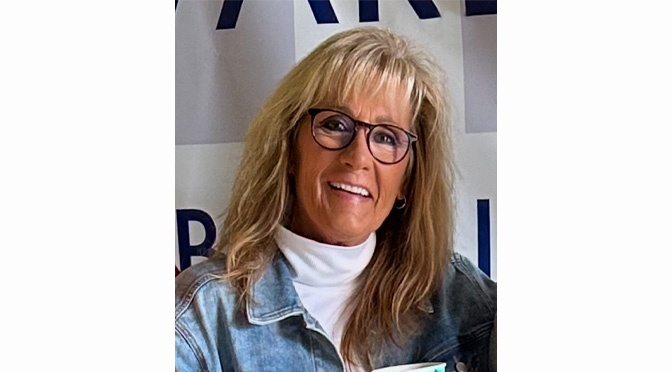
Pam Frebel, 68, smoked for 30 years but was never a heavy smoker. “I would have a few cigarettes a day,” she says. “Never a pack or even a half-pack a day.” Still, she worked as a manager in the gaming industry for 40 years – and, thanks to her work environment, spent a lot of time in smoke-filled casinos. About 10 years ago, her primary care doctor told her she fit the criteria for lung cancer screening with low-dose CT. When she followed through on the advice, it may have saved her life, she says.
Frebel had the yearly scans at St. Luke’s University Health Network’s main campus in Fountain Hill because she was living in the Lehigh Valley at the time.
In 2020, the radiologist who read the annual report saw an area on her left lung that was suspicious. The radiologist suggested she see an oncologist who specializes in lung cancer. The oncologist said Frebel could “wait and see” and have follow-up scans or discuss surgery options that may include the removal of the suspicious growth detected on the CT scan. Frebel said “hell no” to “watchful waiting.”
Early in 2021, Frebel went to see thoracic surgeon Meredith Harrison, MD, at St. Luke’s in Fountain Hill. The two immediately developed a rapport. “I felt instantly that she was the best,” Frebel says. “She is so high-energy, so positive.”
Dr. Harrison gave Frebel similar advice as the oncologist: She could monitor the suspicious growth getting frequent scans or opt for surgery as soon as possible. Frebel’s reaction was the same: Let’s operate now.
Frebel had surgery in the spring of 2021 to remove the affected area of her lung. Post-surgery pathology confirmed that the suspicious area on the CT was very early-stage cancer. Because her cancer was found so early, Frebel does not require any follow-up treatment other than to continue to have yearly lung cancer screening with CT.
Frebel can’t say enough about Dr. Harrison for both her exceptional surgical expertise and her compassionate bedside manner. “Dr. Harrison, and her staff, are just so lovely,” Frebel says.
The U.S. Preventive Services Task Force (USPSTF) and the American Cancer Society recommend annual lung cancer screening for former smokers who are between 50 and 80 years old, have a 20-pack-year smoking history (meaning one pack a day for 20 years, or two packs a day for 10 years), and/or quit within the last 15 years. “I highly recommend anyone who has a smoking history to be screened like I was,” Frebel says. “It can, as I know, save your life.”
About St. Luke’s
Founded in 1872, St. Luke’s University Health Network (SLUHN) is a fully integrated, regional, non-profit network with annual net revenue of more than $4.5 billion. With 23,000+ employees at 16 hospital campuses and 350+ outpatient sites, it is the Lehigh Valley’s biggest employer.
The Network’s service area includes 11 counties in two states: Lehigh, Northampton, Berks, Bucks, Carbon, Montgomery, Monroe, Schuylkill and Luzerne counties in Pennsylvania and Warren and Hunterdon counties in New Jersey. St. Luke’s hospitals operate the largest network of trauma centers in Pennsylvania, with the Bethlehem Campus being home to St. Luke’s Children’s Hospital.
Dedicated to advancing medical education, St. Luke’s is the preeminent teaching hospital in central-eastern Pennsylvania. In partnership with Temple University, the Network established the Lehigh Valley’s first and only four-year medical school. It also operates the nation’s oldest School of Nursing, established in 1884, and 50+ fully accredited graduate medical educational programs with 500+ residents and fellows.
St. Luke’s has been named a Leapfrog Group and Healthgrades Top Hospital and a Newsweek World’s Best Hospital. It is the only Lehigh Valley-based health care system to earn Medicare’s five-star ratings (the highest) for quality, efficiency and patient satisfaction. In 2025, the Network earned straight A’s from Leapfrog across all of its 11 acute care hospitals. It has earned 100 Top Hospital designations from Premier 11 years in a row, including in 2021 when its flagship University Hospital was identified as THE #1 TEACHING HOSPITAL IN THE COUNTRY. Utilizing the Epic electronic medical record (EMR) system for both inpatient and outpatient services, the Network is a multi-year recipient of the Most Wired award recognizing the breadth of SLUHN’s information technology applications such as telehealth, online scheduling and online pricing information.
Information provided to TVL by:
Gary Blockus