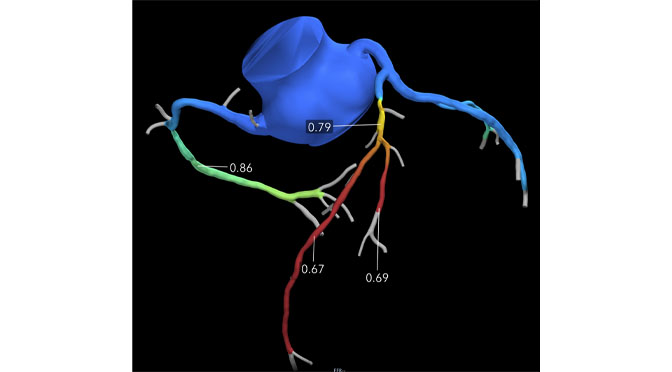
Caption: With Heartflow, a scan is transformed into a dynamic, personalized 3D model of the heart, assessing anatomy and physiology.
Heartflow FFR-CT Analysis can help more accurately determine if a person with suspected coronary artery disease should be treated for heart disease.
St. Luke’s University Health Network now offers a proven, non-invasive diagnostic option for people with suspected heart disease: Heartflow FFR-CT Analysis. This test may reduce the need for invasive cardiac testing and is offered hospitals throughout the Network.
Here’s how it works: Computed tomography (a CT scan) is combined with fractional flow reserve (FFR). This measures the ratio of blood flow in a potentially diseased and narrowed coronary artery to blood flow in the same artery when not constricted. Trained analysts using AI algorithms then create an anatomical model of a person’s heart that helps physicians visualize the blood flow and detect stenosis, or plaque, that obstructs the blood flow.
“Historically, we have been faced with either using tests that were frequently inaccurate or putting a patient through an invasive procedure just to determine whether they would need another invasive procedure to restore blood flow,” said David Furman, MD, St. Luke’s Medical Director of Computed Tomography. “The Heartflow FFR-CT Analysis completely changes this paradigm, providing essential information that can help us determine the right approach for a patient through a convenient, non-invasive platform.”
Heart disease is the leading cause of death for adults in the United States, and coronary artery disease (CAD) is the most common type of heart disease, affecting nearly half the adult population. CAD develops when the arteries leading to the heart narrow or become blocked, which may lead to a reduction in blood flow to the heart. This can cause chest pain, heart attacks and death. Identifying exactly where and how an artery is blocked or clogged can help improve a person’s treatment plan — including whether or not an intervention is needed.
Despite CAD being the most common form of heart disease, studies have shown there is a need to improve how and when CAD is evaluated and diagnosed. Many of the non-invasive tests available today offer a low accuracy rate in detecting CAD. About 4 million diagnostic tests are conducted on patients with chest pain suspected of having CAD each year in the U.S. — many of which are unnecessary.
Purujit Thacker, MD, St. Luke’s cardiologist with expertise in advanced cardiac imaging, also highlighted the benefits of this innovation: “As a cardiologist, my greatest satisfaction comes from preventing heart attacks and other serious cardiovascular events. The Heartflow Analysis enhances our ability to detect and address heart conditions before they become critical, ensuring our patients receive the best possible care.”
Recognized by professional guidelines; backed by data
The Heartflow FFR-CT Analysis offers the highest diagnostic accuracy available from a non-invasive test. Additionally, in clinical trials, using the Heartflow FFR-CT Analysis helped identify which patients do and do not need invasive treatment. The use of the Heartflow FFR-CT Analysis also reduced the cost of care by 26% compared to usual care.
“The Heartflow FFR-CT Analysis will help us develop the most appropriate treatment plan for a patient with coronary artery disease without the need for unnecessary and stressful procedures,” Dr. Thacker said. “This is game-changing technology that will be beneficial for both our patients and the organization.”
A regional leader in cardiac imaging
Heartflow is one of several innovative cardiac imaging technologies offered at St. Luke’s. For patients with symptoms of coronary artery disease, St. Luke’s offers Nuclear Medicine PET Stress Testing, a fast and painless pharmacologic diagnostic test completed in 30 minutes or less. Individuals concerned about their heart health can self-refer for a Coronary Calcium Scoring CT Scan. Offered at mutliple locations throughout the Network, this fast, painless test checks for calcium in the coronary arteries. This screening CT is $99 and gives a detailed cardiac risk profile.
About St. Luke’s
Founded in 1872, St. Luke’s University Health Network (SLUHN) is a fully integrated, regional, non-profit network of more than 20,000 employees providing services at 15 campuses and 350+ outpatient sites. With annual net revenue of $4 billion, the Network’s service area includes 11 counties in two states: Lehigh, Northampton, Berks, Bucks, Carbon, Montgomery, Monroe, Schuylkill and Luzerne counties in Pennsylvania and Warren and Hunterdon counties in New Jersey. St. Luke’s hospitals operate the largest network of trauma centers in Pennsylvania, with the Bethlehem Campus being home to St. Luke’s Children’s Hospital.
Dedicated to advancing medical education, St. Luke’s is the preeminent teaching hospital in central-eastern Pennsylvania. In partnership with Temple University, the Network established the Lehigh Valley’s first and only four-year medical school campus. It also operates the nation’s oldest School of Nursing, established in 1884, and 52 fully accredited graduate medical educational programs with more than 500 residents and fellows. In 2022, St. Luke’s, a member of the Children’s Hospital Association, established the Lehigh Valley’s first and only free-standing facility dedicated entirely to kids.
SLUHN is the only Lehigh Valley-based health care system to earn Medicare’s five-star ratings (the highest) for quality, efficiency, and patient satisfaction. St. Luke’s is a Leapfrog Group and Healthgrades Top Hospital and a Newsweek World’s Best Hospital. The Network’s flagship University Hospital has earned the 100 Top Major Teaching Hospital designation from Fortune/PINC AI 10 years in a row, including in 2021 when it was identified as THE #1 TEACHING HOSPITAL IN THE COUNTRY. In 2021, St. Luke’s was also identified as one of the 15 Top Health Systems nationally. Utilizing the Epic electronic medical record (EMR) system for both inpatient and outpatient services, the Network is a multi-year recipient of the Most Wired award recognizing the breadth of SLUHN’s information technology applications such as telehealth, online scheduling and online pricing information.
Information provided to TVL by:
Sam Kennedy