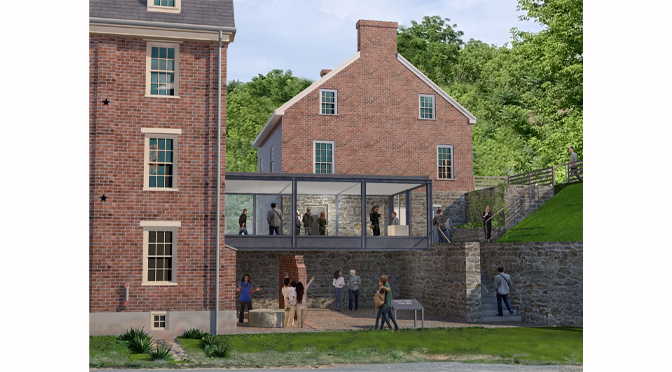


Featured Image: A digital rendering of Overlook on History, provded courtesy of Historic Bethlehem Museums & Sites.

Milestone Commemorated with the Beginning of Construction Work for New Overlook on History Linking Grist Miller’s House with Luckenbach Mill
BETHLEHEM, PA — In the mid-1960s, a small nonprofit made a decision that would forever shape the future of Bethlehem. On July 1, 1966, Historic Bethlehem Inc. (HBI) — a predecessor of Historic Bethlehem Museums & Sites (HBMS) — signed a 99-year lease with the City of Bethlehem to preserve a collection of deteriorating 18th– and 19th-century buildings and ruins along the Monocacy Creek.
That pivotal agreement laid the foundation for one of the most significant preservation movements in Pennsylvania, one that entered its 60th year in July. Today, the 10-acre Colonial Industrial Quarter (CIQ) stands as a beautifully preserved testament to the ingenuity of Bethlehem’s early Moravian settlers and the impact they had on the nation, two of the key attributes that helped land Moravian Church Settlements—Bethlehem on the World Heritage List in 2024.
Among the properties preserved and restored in the CIQ — considered the United States’ earliest industrial center — over the years are the 1762 Waterworks, a National Historic Landmark and the first pumped municipal water system in the American Colonies; the 1761 Tannery, the only extant 18th-century Moravian industrial building in the world; the Luckenbach Mill, built in 1869 on site of the CIQ’s original 1755 grist mill; and the 1782/1834 Grist Miller’s House, which was recently restored and opened to the public after being shuttered for two decades.
To commemorate the milestone, construction workers last week began restoration and stabilization work on the stone wall between the Grist Miller’s House and Luckenbach Mill in preparation for the construction of the $1.5-million Overlook on History, a glass-and-steel classroom and exhibition space that will reconnect the Grist Miller’s House to the Luckenbach Mill — much like the two properties were linked in the 19th century.
“For 60 years, the restoration work in Bethlehem’s Colonial Industrial Quarter has been a shining example of how historic preservation can strengthen a community’s identity and economy,” said Northampton County Executive Lamont G. McClure. “It shows what is possible when a community comes together to protect its history. Northampton County is honored to be a partner in these efforts, which not only highlight our past but also help fuel a thriving downtown and the county’s cultural and economic vitality, keeping Bethlehem the remarkable UNESCO World Heritage Site it is today.”
A Movement Begins
In the mid-1750s, the Colonial Industrial Quarter was bustling with approximately 35 different crafts, trades and industries as the Moravians made everything they needed to live and thrive in Bethlehem. Fast forward 200 years to the 1950s, and the site housed a salvage yard with rows of discarded cars and trucks. Thanks to a concerned group of citizens, led by Ralph Grayson Schwarz, efforts were soon undertaken to preserve the historic buildings before they were lost forever.
A Bethlehem resident and Bethlehem Steel employee, Schwarz (1925-2018) was a driving force in preserving Bethlehem’s Moravian heritage and rich industrial history. During his time in the city, he served in leadership roles at HBI, Bethlehem Visitors Collegium, the Moravian Museum of Bethlehem, Burnside Plantation and Historic Bethlehem Partnership (HBP). Schwarz’s efforts played a key role in the city being designated Pennsylvania’s first National Register Historic District in 1961.
“Ralph was a true visionary who combined engineering, architecture, preservation and leadership skills with a love of history that transformed Bethlehem,” said Jim Miller, who served on nonprofit boards with Schwarz in the 1990s and also collaborated with him on restoration projects when Miller served on the board of Historic Bethlehem Partnership. “His ability to bring people at all levels together in a quiet manner to achieve the unthinkable was extraordinary.”
Originally formed in 1957, HBI eventually became part of Historic Bethlehem Partnership, an umbrella group formed in 1993 to consolidate the operations of several Bethlehem-based museums and historic sites. Also included were Burnside Plantation Inc., Kemerer Museum of Decorative Arts Inc. and Moravian Museum of Bethlehem Inc. In 2022, the organizations then officially merged to become Historic Bethlehem Museums & Sites.
As part of their mission, HBMS and its predecessors have invested millions of dollars into the restoration, preservation and interpretation of Bethlehem’s historic district. Today, HBMS is responsible for managing 20 historic properties and sites throughout the city, including the Moravian Museum of Bethlehem, housed in the 1741 Gemeinhaus, the oldest building in Bethlehem and a National Historic Landmark; and the Kemerer Museum of Decorative Arts, one of only 15 decorative arts museums in the nation. Key restoration projects completed over the decades include:
1761 Tannery
This historic building, now part of Moravian Church Settlements—Bethlehem, was originally restored in the late 1960s and early 1970s. Over the years, the building has undergone upgrades to maintain its historic integrity. Most recently, work has been done to restore the building’s herringbone-patterned doors, dormers and the barge boards at the gable ends of the roof.
1750/1761 Smithy
In 1750, the Moravians built a Smithy housing metal trades in the area along Main Street, with the original building standing until the early 20th century. In 2004, the shop was reconstructed on its original foundation, located adjacent to Hotel Bethlehem. This reconstruction helped renew interest in the Colonial Industrial Quarter, creating a physical and symbolic link between the site and Main Street. The Smithy is open Fridays through Sundays, 11 a.m.-5 p.m., offering an authentic glimpse into blacksmithing life in the mid-1700s.
1810 Goundie House Welcome Center & Schropp Dry Goods Shoppe
Located on Main Street, the 1810 Goundie House is believed to be the first brick residence in the American Federal architectural style built in Bethlehem. Acquired by HBI in 1968, today it serves as Bethlehem’s Welcome Center, greeting thousands of visitors year-round.
The Schropp Shoppe was purchased by HBI in 1997 and has undergone a variety of restoration work over the years. During renovations in the early 2000s, the original doorway between the Goundie House and Schropp Shoppe was discovered and opened, allowing visitors to walk between the two spaces. The revitalization of these two buildings has played a key role in supporting local tourism and furthering Main Street’s reputation as a unique shopping destination.
1782/1834 Grist Miller’s House
Originally home to Bethlehem’s grist miller, the Grist Miller’s House was closed in the mid-2000s due to structural concerns. In 2024, HBMS embarked on an extensive interior and exterior restoration of the property, which is listed on the National Register of Historic Places. A major milestone was achieved in fall 2024 when the steel stabilization beams — installed more than two decades earlier to support the walls — were removed. A centerpiece of the Grist Miller’s House will be the Ralph G. Schwarz Center for Colonial Industries, an educational and programming space honoring Schwarz for his legacy of historic preservation. July 30 marks 100 years since Schwarz’s birth on July 30, 1925.
“We are deeply grateful for the tireless efforts of Historic Bethlehem Museum & Sites in preserving the rich heritage of our city,” said Kenneth Szydlow, Chief Marketing Officer of St. Luke’s University Health Network, which partners with HBMS on CIQ-based events and experiences like the annual Turkey Trot 5K and the Heritage Trail, a self-guided interpretive tour that includes the CIQ buildings and history. “Their dedication to maintaining and restoring these historic properties not only safeguards our past but also enriches our community today. This vibrant historic district offers residents and visitors alike a unique glimpse into Bethlehem’s storied history, which St. Luke’s University Health Network has been privileged to be part of for more than 150 years.”
The Transformation Continues
Following decades of restoration work in the CIQ, the 10-acre parcel is uniquely positioned as an open green space that offers a beautiful, tranquil reminder of Bethlehem’s history and provides opportunities for outdoor recreation. It also stands as the backdrop for world-class events like Musikfest and Celtic Classic, making it an indelible part of Bethlehem’s fabric.
“The Celtic Cultural Alliance, host of the Celtic Classic Highland Games & Festival appreciates the preservation effort that has gone into the Colonial Industrial Quarter,”
said Celtic Cultural Alliance Executive Director Jayne Ann M. Recker. “The CIQ provides the perfect setting for Celtic Classic’s Celtic Heritage Hollow venue, which features cultural and educational presentations. This unique site allows us to present cultural history in a world-famous historical area introducing a large number of visitors to our local heritage they may not have been aware of.”
With the restoration of the Grist Miller’s House now complete, the next major project in the CIQ is the development of the Overlook on History. This modern addition to the site is being designed by nationally renowned architect David Scott Parker, whose credits include numerous National Historic Landmarks ranging from the U.S. Treasury in Washington, D.C. to the Mark Twain House and Greenwich Historical Society in Connecticut. In addition to serving as an educational and community space, the Overlook will offer a panoramic view of the Colonial Industrial Quarter.
“Quite innovative when he introduced the concept, Ralph Schwarz viewed history as an iterative continuum with preservation as a key component in community revitalization,” said Parker, who collaborated with Schwarz on the Tourism Master Plan that eventually led to the formation of Historic Bethlehem Museums & Sites and worked with Schwarz on projects related to the Smithy, Luckenbach Mill, Waterworks and Tannery. “Ralph taught us how to look backward and forward simultaneously — always with a respectful, altruistic sense of purpose, pride and posterity. The Overlook will be both a beacon and a lens that continues this shared vision for Bethlehem’s future.”
While the journey to save Bethlehem’s historic treasures may appear to have been relatively seamless, these efforts are the result of decades of hard work by a community of volunteers, preservation professionals, donors and community-focused organizations.
“Historic Preservation has been a cornerstone of Bethlehem’s revitalization over the past half-century,” said HBMS President and CEO LoriAnn Wukitsch. “From the vision of early leaders like Ralph Schwarz and HBI, to the many groups that have joined together to protect the city’s historic buildings and structures, the work that has been done has laid the foundation for helping to make Bethlehem one of the leading small cities in the nation.
“HBMS greatly appreciates the efforts of the city and everyone who has invested in Bethlehem and its future through historic preservation efforts over the decades. We also look forward to working with our partners and the community to write the next chapters in Bethlehem’s history over the years to come.”
Editor’s Note: The below Dropbox link contains a digital rendering of Overlook on History; before-and-after images of the 1761 Tannery; and photos of Ralph Grayson Schwarz and repair work being done on the wall between the Grist Miller’s House and the Luckenbach Mill in preparation for the construction of the Overlook on History.
Information provided to TVL by:
Mark Demko