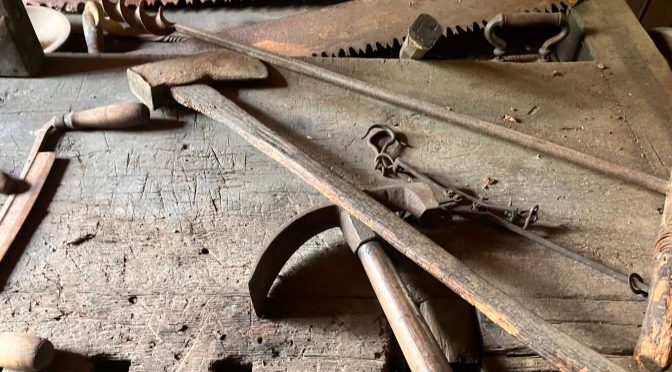


Featured Image: 18th-century tools such as these were used by the Moravians to create products and supplies for the Continental Army during the American Revolution. (courtesy of Historic Bethlehem Museums & Sites)
Exhibit Opening Oct. 3 at Luckenbach Mill Highlights How Moravians Balanced Religious Beliefs with Pressure to Supply Patriots in the Colonists’ Battle with the British
BETHLEHEM, PA—Discover Bethlehem and the Moravians’ unique and complex role during the American Revolution in the dynamic, new exhibition, “Working Hands: Supplying a Revolution,” opening at the 1869 Luckenbach Mill, 459 Old York Road in Bethlehem, on Oct. 3. The exhibit, presented by Historic Bethlehem Museums & Sites (HBMS), explores how the early Moravians worked to maintain their pacifism while at the same time being drawn into the war because of their impressive production capabilities which would become essential to supporting the patriots’ revolutionary cause.
“Working Hands: Supplying a Revolution” will bring to life the story of Bethlehem’s role during the American Revolution through a collection of 18th-century artifacts and reproductions of tools, firearms and products used during that era, complemented by prints and illustrations, engaging video and quotes from Revolutionary leaders who visited the Moravian community during that time. In addition, HBMS is planning a series of related programs and events at the 1750 Smithy, 1782 Grist Miller’s House and other locations in the adjacent Colonial Industrial Quarter (CIQ) to further explore the story leading up to America’s 250th anniversary on July 4, 2026.
When the Moravians settled Bethlehem in the 1740s, they focused on crafts and industry as a means to support the community. Within two years of their arrival, they had built saw, grist, soap and oil mills, as well as a tannery, blacksmith shop and brass foundry. By the mid-1750s, Bethlehem was home to 50 crafts, trades and industries, the majority of them located in the Colonial Industrial Quarter along the Monocacy Creek, making it what is believed to be the first industrial center in nation.
Guided by a deep commitment to spiritual life and missionary work, the Moravians had long avoided political entanglements. However, the start of the Revolutionary War disrupted this neutrality, forcing them to navigate a world where refusal to take sides could be seen as disloyalty.
Patriots quickly noticed the Moravians’ production capabilities, making them a vital resource for the war efforts. Northampton County patriots compelled blacksmiths to manufacture muskets — weapons of war that the Moravians had never before produced — while the skills of potters, shoemakers, woodworkers, tinsmiths, millers, butchers and others were all in high demand.
“Moravians were reluctant to take sides in the conflict between Britain and America, but the Bethlehem community ended up making substantial contributions to the patriot cause in 1776 and after,” said Lehigh University Professor and noted Moravian Historian Scott Paul Gordon. “The most surprising contribution involved hundreds of muskets that Moravian craftsmen produced at the church-operated gun shop. But once Bethlehem became an important location for the Continentals — officers and delegates convened here, supplies were stored here, prisoners were confined here, sick and injured soldiers recuperated here — everybody in Bethlehem had to reorganize how they lived, how they labored and for whom they were laboring.”
In 1776, the Single Brethren’s House was converted into a Continental Army hospital, with Bethlehem housing more than 400 sick, injured and wounded soldiers at one point. As a result of the many needs and demands, the Moravians’ production capabilities were pushed to their limits.
“Bethlehem’s role during the American Revolution was indeed a fascinating one,” said Historic Bethlehem Museums & Sites’ Director of Collections and Programming Mark Steigelman. “We are excited to present this illuminating exhibition that highlights how the Moravians balanced their religious beliefs with the pressures placed upon them at the time. With the 250th anniversary of our nation’s birth approaching, we encourage the community to visit the Luckenbach Mill and the Colonial Industrial Quarter to explore this unique aspect of our nation’s history.”
“Working Hands: Supplying a Revolution” is free and open to the community. Exhibit dates are Fridays-Sundays, 11 a.m.-5 p.m., through Oct. 3, 2026. The exhibition is part of Lehigh Valley 250, a collaboration between regional institutions commemorating 250 years of American independence through insightful and thought-provoking exhibitions, walking tours, events and performances.
Anyone interested in learning more about Moravian Bethlehem during the American Revolution can also take HBMS’s Birthplace of Industry Tour that explores the CIQ. Birthplace of Industry Tours are offered Fridays and Saturdays at 11 a.m., and tickets are available at historicbethlehem.org.
Information provided to TVL by:
Mark Demko