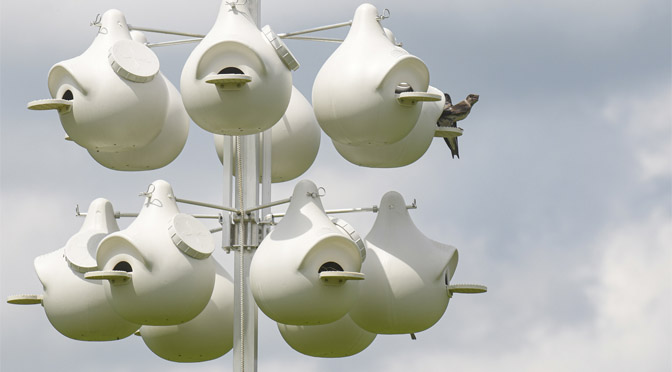
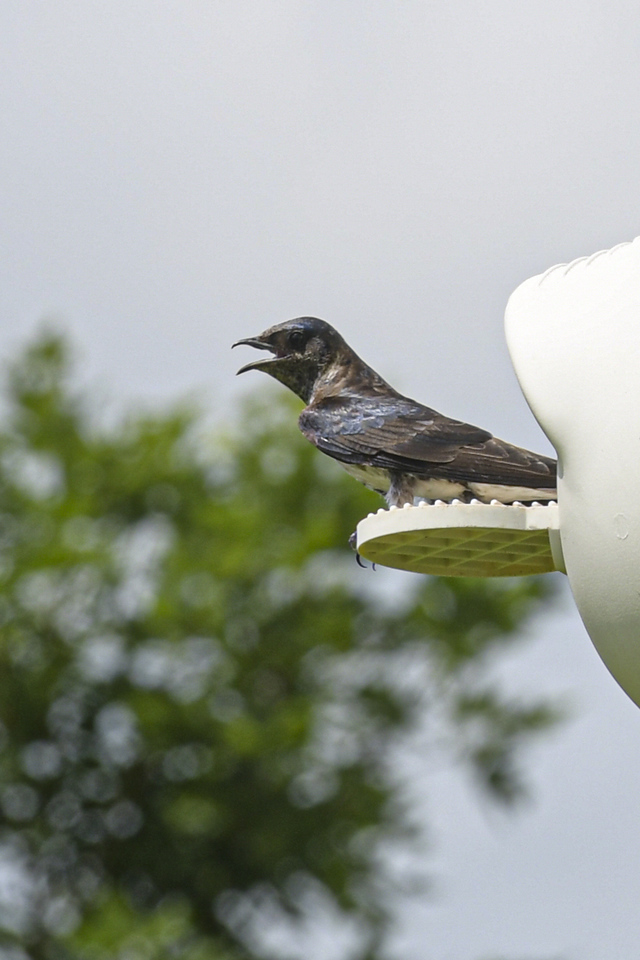
 Purple Martins have found a new home in the Lehigh Valley, establishing a thriving colony within the expansive greenspace at St. Luke’s Anderson Campus in Bethlehem Township.
Purple Martins, which migrate northward from as far south as the Amazon jungle to spend the spring and summer in the United States, were once commonplace in Lehigh and Northampton counties. They depend on man-made nesting sites, which local farmers used to erect since the birds would eat the bugs that might otherwise destroy their crops.
But as farming in this region declined, so too did the Purple Martin population.
To Tom Fiorini, St. Luke’s Director of Landscape Services, this presented an enticing challenge: Could the birds be lured back?
So last winter, in a grove of young maple trees in an arboretum next to a pond at the Anderson Campus, he mounted a tall pole encircled with racks of gourd-shaped bird houses. For months, the bird houses remained vacant – until June. At first, just a few birds moved in. Before long, though, they had some chicks, and now the whole complex is bustling.
Photographs of the birds were sent to the Cornell Lab of Ornithology in Ithica, N.Y., which confirmed they were Purple Martins. Peter Saenger of Muhlenberg College’s Acopian Center for Ornithology also reviewed the photographs and reached the same conclusion.
“To have first year success, means you have a very good location,” Saenger said, who noted that east of the Mississippi River, Purple Martins are 100% dependent on man-made nests. “So, what you have done there is phenomenally important.”
Purple Martins’ symbiotic relationship with humans predates the arrival of Europeans to North America. Indians were the first to recognize their utility for pest control and use gourd nesting sites to attract them.
The largest of the New World swallows, Purple Martins are acrobatic flyers that love nothing more than gorging themselves on flying insects which, of course, are no less of a nuisance for people today than they were for the Indians and farmers of the past. The birds tend to nest near permanent water sources, such as ponds – of which the 500-acre Anderson Campus has several, as well as proximity to the Lehigh River.
The Anderson Campus is also home to an organic farm that grows healthy produce for the hospital and acres upon acres of sunflower fields, so insect life flourishes there, making it ideal habitat for Purple Martins and many other species too.
When St. Luke’s landscape director Fiorini is working at the Anderson Campus, he checks on his Purple Martins and takes great pleasure in watching them snatch flying insects out of the air to feed their insatiable chicks. “The coolest thing,” he said, “is that they are going to know this spot, and they’ll keep coming back year after year.”
About St. Luke’s
Founded in 1872, St. Luke’s University Health Network (SLUHN) is a fully integrated, regional, non-profit network with annual net revenue of more than $4 billion. With 23,000+ employees at 16 hospital campuses and 350+ outpatient sites, it is the Lehigh Valley’s biggest employer.
The Network’s service area includes 11 counties in two states: Lehigh, Northampton, Berks, Bucks, Carbon, Montgomery, Monroe, Schuylkill and Luzerne counties in Pennsylvania and Warren and Hunterdon counties in New Jersey. St. Luke’s hospitals operate the largest network of trauma centers in Pennsylvania, with the Bethlehem Campus being home to St. Luke’s Children’s Hospital.
Dedicated to advancing medical education, St. Luke’s is the preeminent teaching hospital in central-eastern Pennsylvania. In partnership with Temple University, the Network established the Lehigh Valley’s first and only four-year medical school. It also operates the nation’s oldest School of Nursing, established in 1884, and 50+ fully accredited graduate medical educational programs with 500+ residents and fellows.
St. Luke’s has been named a Leapfrog Group and Healthgrades Top Hospital and a Newsweek World’s Best Hospital. It is the only Lehigh Valley-based health care system to earn Medicare’s five-star ratings (the highest) for quality, efficiency and patient satisfaction. In 2025, the Network earned straight A’s from Leapfrog across all of its 11 acute care hospitals. It has earned 100 Top Hospital designations from Premier 11 years in a row, including in 2021 when its flagship University Hospital was identified as THE #1 TEACHING HOSPITAL IN THE COUNTRY. Utilizing the Epic electronic medical record (EMR) system for both inpatient and outpatient services, the Network is a multi-year recipient of the Most Wired award recognizing the breadth of SLUHN’s information technology applications such as telehealth, online scheduling and online pricing information.
Information provided to TVL by:
Sam Kennedy