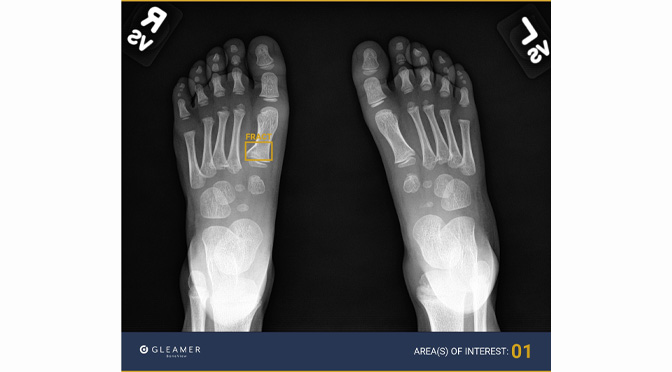
Photo caption: Gleamer BoneView AI identifies bone abnormalities, placing a yellow box around areas of concern in an image.
St. Luke’s University Health Network, a national leader in the use of artificial intelligence, has adopted new AI technology to assist in the review of emergency department X-ray images to identify bone trauma such as fractures, dislocations, effusions and lesions.
The Network is the first in the region to deploy the new diagnostic tool – Gleamer BoneView AI – at all of its acute care hospital ERs and Care Now walk-in urgent care centers.
“St. Luke’s is committed to advancing patient care through investments in artificial intelligence for medical imaging,” St. Luke’s Radiology Chairman Dr. Robert Fournier said. “By integrating AI into diagnostic imaging workflows, St. Luke’s enhances the accuracy, speed and consistency of image interpretation. This enables quicker and potentially more precise diagnoses while also improving overall efficiency.”
Clinical studies have shown that Gleamer BoneView AI reduces missed fractures by up to 30%.
St. Luke’s introduced the technology at some of its hospital emergency departments late last year. With the recent installation at the St. Luke’s Grand View campus in Sellersville, it is now in use at all of St. Luke’s hospital emergency rooms.
Trained on a massive database of X-ray images and powered by deep learning algorithms, Gleamer BoneView AI identifies bone abnormalities, placing a yellow box around areas of concern in an image. It is especially adept at identifying subtle signs of mild bone breaks such as buckle fractures.
St. Luke’s Chair of Emergency Medicine Dr. Rebecca Pequeno said the technology supplements human training and expertise, allowing emergency department clinicians to interpret images with greater speed and accuracy before the images are sent to radiologists for final review.
“It’s like having a helpful second set of eyes when reviewing X-ray images,” Pequeno said.
While St. Luke’s Radiology Department first began using AI to assist in the review of some X-ray images seven years ago, Gleamer BoneView AI is the first Network-wide project of its kind – applied on average to more than 1,000 X-ray images every day.
Throughout its 16 campuses and 350+ outpatient locations, St. Luke’s uses AI across various aspects of its operations to enhance patient care and improve efficiency, including AI-powered medical imaging for faster and more precise diagnoses of stroke and other afflictions and for predictive analytics to assess risks for complications such as sepsis.
The Network is involved in over 100 AI projects, one-third of which have been fully integrated into operational workflows. The remainder are in the testing or preliminary evaluation stages.
Dr. Fournier noted that St. Luke’s adoption of Gleamer BoneView AI presents an important educational opportunity for the Network’s physicians in residency and fellowship training programs.
“Our residents and fellows will gain hands-on experience with the latest AI-driven imaging technology,” he said, “placing them at the forefront of next-generation medicine and allowing them to witness firsthand how innovation improves patient care and outcomes.”
About St. Luke’s
Founded in 1872, St. Luke’s University Health Network (SLUHN) is a fully integrated, regional, non-profit network with annual net revenue of more than $4 billion. With 23,000+ employees at 16 hospital campuses and 350+ outpatient sites, it is the Lehigh Valley’s biggest employer.
The Network’s service area includes 11 counties in two states: Lehigh, Northampton, Berks, Bucks, Carbon, Montgomery, Monroe, Schuylkill and Luzerne counties in Pennsylvania and Warren and Hunterdon counties in New Jersey. St. Luke’s hospitals operate the largest network of trauma centers in Pennsylvania, with the Bethlehem Campus being home to St. Luke’s Children’s Hospital.
Dedicated to advancing medical education, St. Luke’s is the preeminent teaching hospital in central-eastern Pennsylvania. In partnership with Temple University, the Network established the Lehigh Valley’s first and only four-year medical school. It also operates the nation’s oldest School of Nursing, established in 1884, and 50+ fully accredited graduate medical educational programs with 500+ residents and fellows.
St. Luke’s has been named a Leapfrog Group and Healthgrades Top Hospital and a Newsweek World’s Best Hospital. It is the only Lehigh Valley-based health care system to earn Medicare’s five-star ratings (the highest) for quality, efficiency and patient satisfaction. In 2025, the Network earned straight A’s from Leapfrog across all of its 11 acute care hospitals. It has earned 100 Top Hospital designations from Premier 11 years in a row, including in 2021 when its flagship University Hospital was identified as THE #1 TEACHING HOSPITAL IN THE COUNTRY. Utilizing the Epic electronic medical record (EMR) system for both inpatient and outpatient services, the Network is a multi-year recipient of the Most Wired award recognizing the breadth of SLUHN’s information technology applications such as telehealth, online scheduling and online pricing information.
Information provided to TVL by:
Sam Kennedy