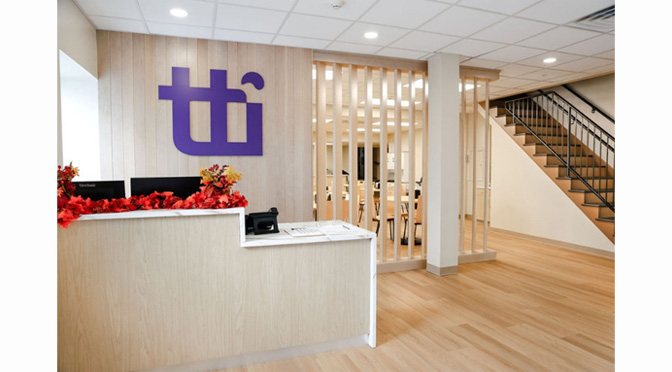


Interior view of the newly renovated Treatment Trends Allentown Residential facility at 18 S. 6th Street in Allentown. The $1 million renovation, funded through Pennsylvania opioid settlement dollars, modernized living spaces and added elevator accessibility, restoring critical residential treatment capacity in Lehigh County. (Photo credit: Photography by AK Photo)
ALLENTOWN, Pa., February 19, 2026 – Access to addiction treatment in Lehigh County continues to expand with the grand reopening of Treatment Trends Allentown Residential following a major renovation supported by $1 million in opioid settlement funds from the Pennsylvania Department of Drug and Alcohol Programs (DDAP). A grand re-opening and ribbon cutting will be held Friday, March 6, 2026, from 11:00 a.m. to 1:00 p.m. at 18 S. 6th Street, Allentown. The event is open to referral sources, providers, community partners and media.
The residential treatment facility, formerly known as Keenan House, was forced to close in June 2024 due to the aging building and escalating maintenance costs. Shortly after taking office, District Attorney Gavin Holihan identified an unspent $1 million grant through the Pennsylvania Department of Drug and Alcohol Programs (DDAP), funded by the statewide opioid settlement. In collaboration with Lehigh County Drug and Alcohol, County Commissioners and DDAP, the grant was successfully rewritten to fund comprehensive renovations of the aging building.
Construction was completed in fall 2025. The program quietly resumed operations in December and is currently serving 10 residents, with capacity for fifty individuals once fully stabilized.
“This reopening represents what is possible when systems work together with urgency and purpose,” said Joe Martellucci, Lehigh County Drug and Alcohol Administrator. “We were facing permanent loss of treatment beds. Our office, the District Attorney, County leadership, and DDAP all came to restore and strengthen high-quality treatment for people and families in Lehigh County.”
“When people receive treatment close to home, connected to family and community, their chances of sustained recovery increase dramatically,” said John Dillensnyder, Executive Director of Treatment Trends. “By reopening this building in Allentown, we are restoring hope, structure and opportunity.”
The renovated facility now includes modernized living spaces, improved safety features and full elevator accessibility, creating a welcoming, recovery-centered environment. Interior design was completed by Alloy5, with construction by Elevate Construction Partnership. No taxpayer dollars were used to complete the project, and Lehigh County is utilizing a portion of its opioid settlement allocation to support staffing during the relaunch period until census levels reach sustainability.
With its reopening, Treatment Trends has launched a specialized treatment track focused on individuals returning from incarceration. The program integrates family engagement and community reintegration planning to reduce relapse risk and support long-term stability.
“Strong communities require both accountability and opportunity,” said District Attorney Holihan. “Expanding high-quality residential treatment, especially for individuals reentering our community from incarceration, improves long-term recovery outcomes and strengthens public safety for everyone in Lehigh County.”
District Attorney Gavin Holihan will be a featured speaker at the March 6 event, alongside Allentown Residential Facility Director Chelsea Edmunds, and Treatment Trends Executive Director John Dillensnyder. Doors open at 11:00 a.m., remarks and ribbon cutting will begin at approximately 11:15 a.m., and lunch and tours will follow. Lunch will be catered by Tacos Y Tequila, with refreshments and other event elements underwritten by the Center for Humanistic Change.
Overdose deaths in Lehigh County have trended downward in recent years, reflecting coordinated investments in prevention, treatment, and recovery support. Maintaining strong residential treatment capacity remains a key component of that strategy.
Event Details:
Treatment Trends Allentown Residential Grand Reopening & Ribbon Cutting
Friday, March 6, 2026 | 18 S. 6th Street, Allentown, PA
11 a.m.–1 p.m. (remarks at 11:15 a.m.)
Hosted by Lehigh County Drug & Alcohol, Treatment Trends Inc., Center for Humanistic Change
More Information: https://www.treatmenttrends.org/allentown-residential
About Lehigh County Drug and Alcohol
Lehigh County Drug and Alcohol is the county’s central agency for planning, funding, and coordinating behavioral-health services related to substance use and recovery. The department works closely with treatment providers, healthcare systems, schools, law enforcement, and community partners to deliver prevention programming, screenings and assessments, outpatient and inpatient treatment referrals, case management, and recovery supports. Recent investments—guided by community need and supported in part by opioid settlement funds—have expanded local treatment capacity and harm-reduction services, including Narcan distribution and community education initiatives. Lehigh County Drug and Alcohol is committed to reducing barriers to care, promoting evidence-based practices, and supporting people and families on the path to sustained recovery. To learn more about county services and local resources, visit RiseAboveOpioids.org or contact Lehigh County Drug and Alcohol.
About Treatment Trends Inc.
Treatment Trends, Inc. (TTI) is a 501(c)(3) nonprofit organization dedicated to providing treatment for substance use disorders since 1969. The organization’s mission is to lessen the suffering caused by addiction by offering passionate treatment services through a continuum of care. TTI’s vision is to help individuals achieve long-term recovery, enabling them to live full, healthy, and happy lives. The organization operates programs and centers in Lehigh and Northampton counties, offering a range of services including inpatient and outpatient treatment, MAT support, and recovery support services.
Information provided to TVL by:
Tiffany Sondergaard